
Cycling is a sport of cruel, binary extremes. On Tuesday, Søren Wærenskjold crossed the finish line at Le Lioran dead last, battered from a crash, dragging his bike home in the gruppetto.
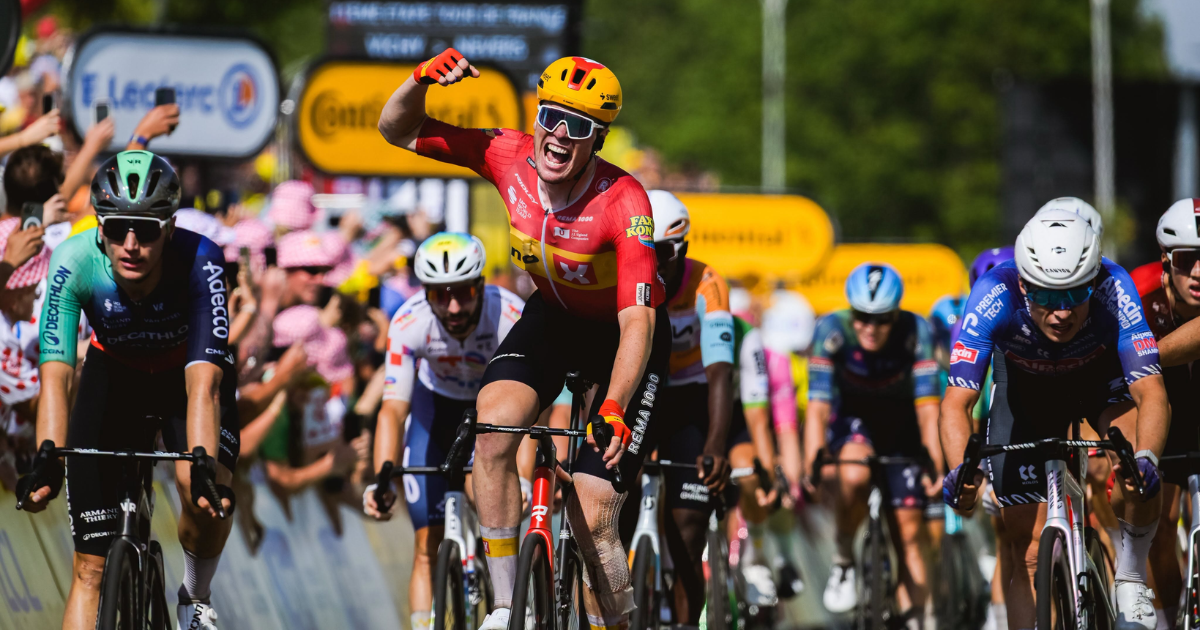
Twenty-four hours later, the 26-year-old Norwegian launched a audacious, long-range gamble to win Stage 11 in Nevers—immortalizing himself in the fastest road stage in the 113-edition history of the Tour de France.
By the time the peloton reached Nevers after 161.3 kilometres from Vichy, they had averaged an astonishing 50.91km/h — making it the fastest road stage ever recorded in the 113 editions of cycling’s most prestigious race.
But when the inevitable bunch sprint materialized in Nevers, it wasn’t the meticulous lead-out trains of the sport’s elite sprinters that dictated the outcome.
Instead, it was an anarchic, unstructured drag race on narrow roads that rewarded sheer instinct and a “nothing to lose” mentality.
Wærenskjold (Uno-X Mobility) timed his blast perfectly from 350 meters out, holding off furious, late surges from stage five winner Olav Kooij (Decathlon CMA CGM) and Jasper Philipsen (Alpecin-Premier Tech) to secure the biggest victory of his career.
“It means everything, it’s my biggest win so far,” a stunned Wærenskjold said post-match. “Sometimes I have really good confidence and I believe in myself, but there’s many, many times where I feel super tired and it’s impossible to win here.”
The Anatomy of a Historical Drag Race
The record-breaking pace was set early in the ancient spa town of Vichy. Under brief, welcome rain that quickly gave way to returning heat, a four-man breakaway featuring Julian Alaphilippe, Mathis Le Berre, Nelson Oliveira and Anthon Charmig attempted to upset the sprint teams, but the peloton never allowed them significant freedom. Backed by favourable tailwinds and determined chase work from teams protecting their fast men, the escape group’s advantage rarely stretched beyond one minute and forty seconds.
The sprint teams kept the gap tightly controlled, refusing to let the gap extend beyond 1 minute and 40 seconds and ensuring the breakaway never gained enough time to seriously threaten the expected bunch finish.
The resulting chase turned the stage into a continuous, high-speed crucible. Even after Alaphilippe dropped back, the surviving trio forced the peloton to burn through its resources, only being reeled in with just 6 kilometers remaining.
“Today was a strong breakaway, that’s why the speed has to be high,” explained yellow jersey holder Tadej Pogačar, who finished safely in the pack to maintain his three-and-a-half-minute general classification lead over Jonas Vingegaard. “The biggest reason is also the tailwind. With a headwind, it would be much less speed. But when you have such a strong breakaway in front, you go fast.”
“Very, Very Sketchy”: The Sprint Controversy
Unlike the textbook sprint finishes often seen at the Tour, the run into Nevers quickly descended into disorder.
Narrow roads prevented teams from fully organising their lead-out trains, while the frantic battle for position left several of the race’s biggest sprint outfits scrambling for control.
Belgian Tim Merlier, winner of two previous stages and one of the favourites for the day, found himself repeatedly boxed in and unable to launch a meaningful challenge.
“It was hectic,” a frustrated Merlier said. “They blocked the road and with 2km to go we started to try to lead it out but I didn’t find a place to launch a sprint.”
Veteran German rider John Degenkolb was even more critical of the Tour’s routing choices. “Everyone knew the final was very, very sketchy,” Degenkolb remarked. “The road was quite narrow from 6km to go. It was crazy stress and chaotic… I don’t think it was the best place to finish a stage like that.”
The chaos extended past the finish line. Jasper Philipsen initially crossed in third but was immediately relegated to 119th by the race jury for allegedly veering into another rider. However, following a frantic post-race appeal, officials overturned the sanction, reinstating the Belgian to the bottom step of the podium.
The Instinct of the Underdog
Where others saw danger and restriction, Wærenskjold saw an opening.
As the primary sprinters hesitated in the final 400 meters, Cees Bol launched off the front to set up Kooij. Wærenskjold didn’t wait for a lead-out; he anticipated the move, threw caution to the wind, and exploded down the right-hand side of the tarmac.
By the time Kooij and Philipsen reacted, the Norwegian had already opened a crucial advantage.
Ironically, Wærenskjold credits his miserable performance the day prior for giving him the psychological freedom to pull off the heist.
“If I didn’t have the crash yesterday, I don’t think I would have taken that gap,” Wærenskjold admitted. “I tried to follow my instinct. Even though I crashed yesterday, I probably wouldn’t have done the same as I did today if everything was normal. I had nothing to lose.”
For Uno-X Mobility, the victory marked the team’s second Tour de France stage win
More importantly, it serves as a modern validation of their aggressive, opportunistic racing philosophy. In a sport increasingly dominated by marginal gains and calculated data, Stage 11 proved that sometimes, raw instinct and absolute desperation are still the fastest things on two wheels.
No Change at the Top
While the sprint battle delivered drama at the finish, the general classification remained unchanged.
Pogačar safely crossed the line with the main contenders to retain a commanding lead of more than three and a half minutes over Jonas Vingegaard.
With the mountains still to come, the race for yellow remains firmly under the Slovenian’s control.
But Stage 11 belonged to Wærenskjold.
On the fastest day the Tour de France has ever seen, the Norwegian found the perfect moment to produce the fastest ride of his life.











“I never thought I’d enjoy training this much until joining Sportif. The coaches are supportive and really know how to bring out the best in you.”