
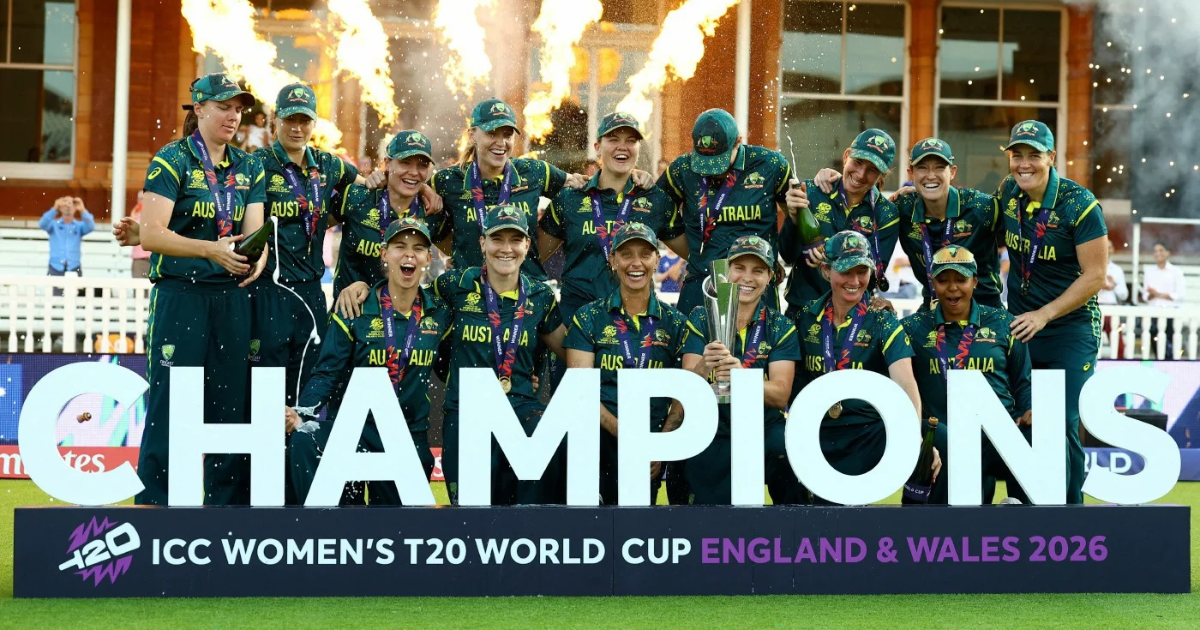
True athletic greatness isn’t merely defined by reaching the summit; it is measured by the casual, almost routine ease with which you stay there.
In front of a record-breaking, sold-out crowd of over 28,000 spectators at Lord’s Cricket Ground, the Australian women’s cricket team did what they do better than any sports franchise on the planet: they turned a high-stakes World Cup final into a comprehensive masterclass.
By dismantling host nation England by seven wickets on Sunday, Australia didn’t just capture their seventh ICC Women’s T20 World Cup title—and a staggering 14th global crown overall—they completely shattered England’s historically perfect record at home-soil World Cups.
In doing so, they also executed the highest successful run chase in the history of Women’s T20 World Cup finals.
Throwing the First Punch
Entering the final, both archival rivals boasted flawless 6-0 records in the tournament.
Yet, from the moment Australian captain Sophie Molineux won the toss and elected to field, the visitors dictated the tempo.
Australia’s bowling unit choked out England’s explosive top order with clinical, suffocating precision.
Twenty-year-old left-arm fast bowler Lucy Hamilton set the tone immediately. Hamilton struck with her very first over, forcing an edge from opener Amy Jones into the hands of Georgia Voll at gully.
When tournament leading run-scorer Danni Wyatt-Hodge gloved a delivery from Annabel Sutherland down the leg side, wicketkeeper Beth Mooney completed a phenomenal tumbling catch.
The dismissal marked Sutherland’s 50th wicket in T20 Internationals and left England gasping at 39-2 within the powerplay.
England captain Nat Sciver-Brunt, still managing a calf injury that sidelined her for much of the group stage, single-handedly anchored the recovery.
Fighting her way to a resilient 58 off 53 balls, Sciver-Brunt combined with young sensation Freya Kemp (a quickfire 44 off 28 balls) for an unbroken 80-run partnership.
Kemp injected some late drama by launching a straight six off Molineux in the final over, dragging England to a competitive, yet vastly under-par, total of 150/4.
“Nerves of Steel” and the Masterful Chase
If England hoped their late-innings momentum would rattle the reigning champions, Georgia Voll corrected that notion instantly, dispatching the very first ball of the chase for four.
Though Voll fell early to Lauren Bell, her departure simply set the stage for a spectacular, game-defining 100-run partnership between Beth Mooney and Phoebe Litchfield.
Litchfield provided raw, effortless power—clearing the ropes twice in a rapid 48 off 35 balls—while Mooney operated with surgical efficiency.
Mooney’s clinical 64 off 49 balls featured ten boundaries and secured her status as the Player of the Tournament.
Remarkably, this marked her third half-century in a T20 World Cup final following legendary outings in 2020 and 2023.
“She is probably the smartest cricketer I’ve ever played with,” skipper Sophie Molineux said of Mooney post-match. “The way she can sum up situations and grind out innings… she’s got nerves of steel.”
By the time Litchfield was bowled by Charlie Dean and Mooney fell leg-before to Sophie Ecclestone, the damage was irreversible.
Icons of the era Ellyse Perry and Ashleigh Gardner comfortably steered Australia across the finish line with nearly three overs to spare, fittingly sealed via four wayward wides from Ecclestone.
No Answers to the Generational Blueprint
The defeat continues a brutal psychological trend for the English, who have now lost all seven of their World Cup final encounters against Australia across both ODI and T20 formats.
Despite the heartbreak, Nat Sciver-Brunt dismissed suggestions of a psychological block. “The overriding feeling is that we’ve lost a World Cup final, not ‘oh no, it’s Australia again,'” she insisted.
For England coach Charlotte Edwards, the reality is far more straightforward.
“They have led the way for years,” Edwards admitted. “You have to be at your best to beat them, and we weren’t.”
For captain Sophie Molineux, lifting the trophy was a deeply personal vindication. Appointed in January following Alyssa Healy’s retirement, Molineux faced intense internal and external doubts after missing crucial stretches of the home summer with a recurring back issue.
“I suppose there were a few doubts… but you just have to keep believing, I’m incredibly lucky that people believed in me.”
,Molineux reflected while holding the silverware.
With a perfect blend of modern youth like Hamilton and Litchfield alongside the icy composure of veterans like Mooney and Perry, Australia’s era of dominance shows zero signs of fracturing.
They came, they threw the first punch, and they left the Home of Cricket completely untouched.












“I never thought I’d enjoy training this much until joining Sportif. The coaches are supportive and really know how to bring out the best in you.”