
And so, the longest-running soap opera in modern international football reaches its final, predictable episode.
When the referee blew the whistle at AT&T Stadium on Tuesday night, it did not just signal Spain’s passage to the 2026 World Cup final.
It brought a definitive, screeching halt to the 14-year, 184-game reign of Didier Deschamps.
For over a decade, Deschamps’ philosophy was simple, robust, and wildly successful: keep the tactics uncomplicated, protect the squad’s morale, and let an absurd concentration of individual talent win football matches.
It was an approach that yielded the 2018 World Cup, a fingernail-close runner-up finish in 2022, and a Nations League trophy.
But against a modern, highly structured Spain team that simply refused to let France have the ball, the limits of pure pragmatism were laid bare.
France bowed out not with a heroic, desperate fight, but with a whimpering, tactical surrender—cobbling together a miserable 0.04 expected goals (xG) in the first 64 minutes of the match.
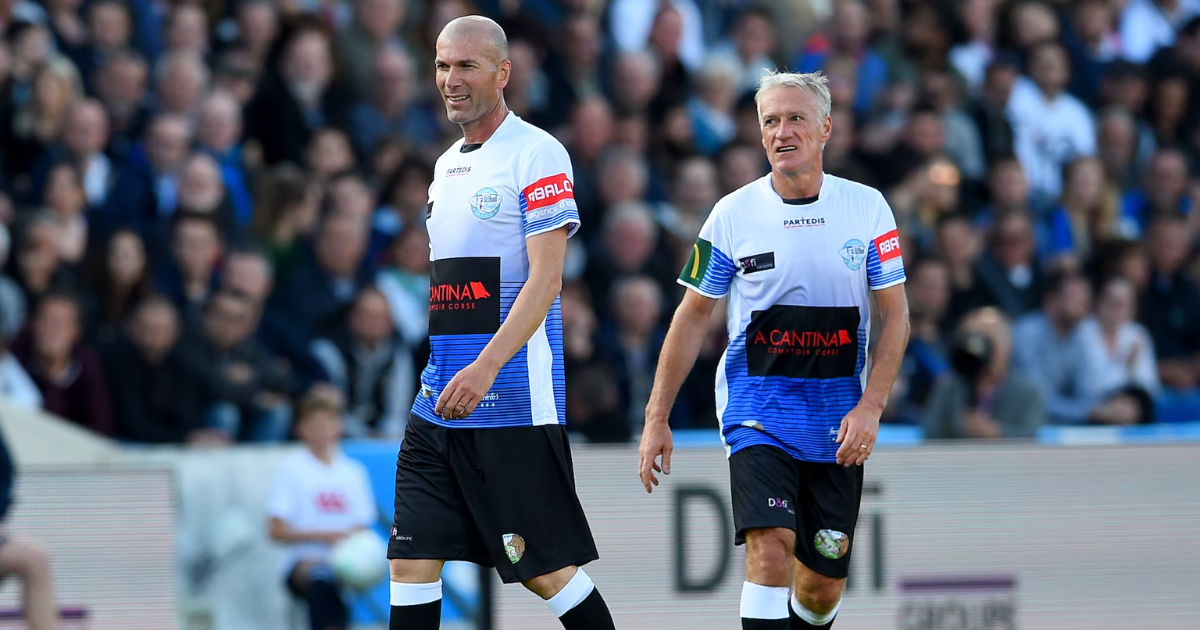
Now, as the French Football Federation prepares to send formal contract papers to Zinedine Zidane, French football stands at a fascinating precipice. The Deschamps era is dead. The “Zizou” era is about to begin.
But for a fanbase desperate for a modern tactical revolution, the transition might come with a heavy dose of déjà vu.
The Kryptonite of Rigidity
Deschamps’ success was built on conventional wisdom. In international football, where coaching time is limited, over-complicating things can be fatal.
But the fatal flaw of this philosophy is its complete inability to adapt when an opponent denies you the two things elite players need: possession and space.
Against Luis de la Fuente’s Spain, France faced their ultimate tactical mismatch. For the third time in three years—following the Euro 2024 semi-final and a 2025 Nations League battering—Spain completely overran the French midfield.
Squeezed into a 2-on-3 deficit in the center of the park, Adrien Rabiot and Aurélien Tchouaméni spent the evening chasing shadows.
“We kept finding ourselves outnumbered,” Kylian Mbappé admitted post-match. It was a glaring issue that was obvious to everyone in the stadium, yet Deschamps refused to adjust.
Instead of adding a third midfielder to match Spain’s structure, Deschamps gambled on his default setting: wait for a moment of individual magic.
When that magic never materialized, his substitutions—the like-for-like swaps of Manu Koné and Désiré Doué—felt less like tactical chess and more like the predictive text on a smartphone. Predictable, safe, and ultimately ineffective.
The Legacy Left Behind
It is easy to criticize Deschamps in the wreckage of a semi-final defeat, but his legacy remains monumental. Since taking over in 2012, he rebuilt a fractured, toxic national team culture and turned Les Bleus into a brutal, winning machine.
He joins Mário Zagallo and Franz Beckenbauer in the exclusive club of men who have won the World Cup as both a player and a manager.
He managed more World Cup matches (26) than anyone in history. He fell just one penalty shootout away in Qatar from securing back-to-back world titles.
But international football has evolved rapidly over the last four years. The physical, transition-heavy style that dominated the late 2010s is increasingly vulnerable to sophisticated, high-pressing possession units.
Deschamps leaves a squad whose recent defeats to Spain have raised questions about whether France possess enough tactical flexibility against elite possession-based opponents.
A Squad Built to Win Now
What makes France’s semi-final exit feel so jarring is not the result itself. Losing to Spain is hardly a disgrace. The concern lies in how it happened.
This was arguably the deepest French squad assembled since the golden generation of the late 1990s and early 2000s. Mbappé remains one of football’s defining superstars.
Dembélé arrived as the reigning Ballon d’Or holder. Olise had enjoyed a breakout campaign at Bayern Munich, while Barcola emerged as one of Europe’s most exciting attacking talents.
Behind them sits another wave already pushing through the door.
France are not entering a rebuilding phase. They are entering a period where expectations remain unchanged. The objective under Zidane will not be development, experimentation or transition. It will be winning.
That reality raises the pressure immediately.
Deschamps often operated as the stabiliser after years of turbulence within the French setup. Zidane, by contrast, arrives as a romantic figure. A national icon. A World Cup winner. A manager whose name alone evokes memories of France’s greatest footballing moments.
The challenge is that nostalgia rarely wins tournaments.
The version of Zidane that supporters imagine and the version that eventually takes the touchline may not be the same.
Managing a national team built around Mbappé, Dembélé and a new generation of stars will require more than charisma and aura. It will require solutions.
And after what Spain exposed in Arlington, there are questions waiting to be answered.
Zidane: Saviour or Mirror Image?
The clamor for Zinedine Zidane has been building for years. The legendary midfielder has largely stayed out of management while awaiting an opportunity many have long considered his natural destination, having received a verbal agreement from the French Football Federation that the national team job would be his once Deschamps stepped aside after this tournament.
On paper, the appointment is a home run. Zidane is French footballing royalty, a man who commands instant, unquestioned respect from a dressing room full of egos. His managerial résumé at Real Madrid is staggering: three consecutive UEFA Champions League titles and two La Liga crowns.
Yet, a closer look at Zidane’s coaching profile suggests he may be closer to Deschamps than many fans care to admit.
At the Santiago Bernabéu, Zidane was not a tactical innovator in the mold of Pep Guardiola or Jürgen Klopp. He was, much like Deschamps, a supreme man-manager.
He excelled at keeping superstars happy, managing dressing room politics, and deploying simple, balanced structures that allowed his world-class individuals to decide games.
Furthermore, international management is a vastly different beast. Zidane has not coached a football match in five years.
His only managerial experience has been at Real Madrid—a unique, hyper-funded environment where tactical deficiencies can be papered over by signing another Galáctico. In the international arena, you cannot buy a new central midfielder when your current options are getting overrun.
What Could Have Been—And What Must Be
When Zidane officially takes charge ahead of September’s UEFA Nations League matches, he will inherit a golden generation of French talent that is still very much in its prime.
The question is whether Zidane has spent his five-year hiatus studying the shifting tactical sands of the modern game, or if he will rely on the same hands-off, motivational style that defined his Madrid tenure.
If it is the latter, France may find themselves back in the same position in two years’ time—wondering why a team of superstars looks so ordinary when the ball is taken away from them.
Zidane knows what it takes to win. He won a World Cup with Stéphane Guivarc’h upfront, and he conquered Europe with Cristiano Ronaldo.
Arlington served as a reminder that elite talent alone is not always enough at the highest level. Against the most organised opponents, structure, balance and collective execution still matter.
Zidane inherits one of the most gifted squads in world football. The challenge now is turning that talent into a team capable of reclaiming the game’s biggest prize.










“I never thought I’d enjoy training this much until joining Sportif. The coaches are supportive and really know how to bring out the best in you.”